
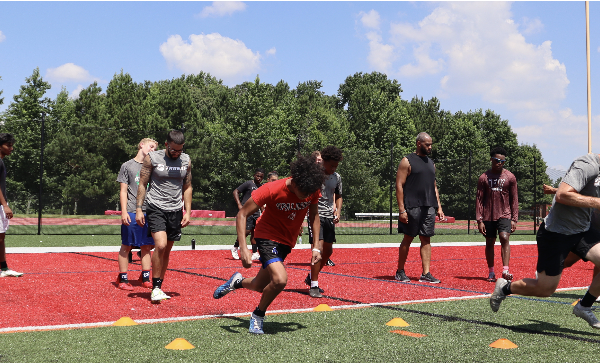
In sports, the first few steps can make all the difference. Whether an athlete is chasing down a ball, creating separation from a defender, closing a gap, or sprinting toward the finish line, the ability to accelerate quickly can determine who wins the play.
That first burst of speed is called acceleration, and it is one of the most important physical qualities an athlete can develop.
While top-end speed gets plenty of attention, most sports are played through short bursts of movement rather than long, straight sprints. Athletes constantly accelerate, decelerate, and change direction. Developing better acceleration can help athletes react faster, create more space, and perform with greater confidence.
But how do you know where an athlete is losing speed, and what should they focus on to improve?
That’s where objective speed testing, like Universal Speed Rating (USR), comes in.
Why Acceleration Is Important for Athletic Performance
Acceleration is an athlete’s ability to increase speed from a stationary or slower position. It plays a major role in almost every sport, particularly those that require quick reactions, short sprints, and frequent changes in direction.
Here are four ways improved acceleration can give athletes a competitive advantage.
1. Win the First Few Steps
A quicker first step can help an athlete reach the ball, create separation from an opponent, or get into position before someone else. In sports where opportunities happen in a split second, even a small improvement in acceleration can make a difference.
2. Create More Time and Space
Accelerating quickly allows athletes to close gaps, gain positioning, and create separation. Getting to a position sooner can give an athlete more time to make their next move while limiting the opponent’s available options.
3. Make Better Decisions Under Pressure
When athletes can move efficiently and keep up with the pace of play, they have more opportunities to read the game rather than constantly trying to catch up. Better acceleration can help athletes stay in control and respond more effectively to changing situations.
4. Improve Performance Across Multiple Positions
Acceleration isn’t limited to one position or type of athlete. Offensive players use it to create opportunities, defensive players rely on it to close space, and athletes in transition need it to quickly change their pace and positioning.
Regardless of the sport, developing acceleration can translate into better overall athletic performance.
You Can’t Improve What You Don’t Measure
Many athletes and parents understand that speed is important, but knowing an athlete needs to get faster and knowing exactly how to improve are two different things.
Is the athlete struggling with the initial first step? Do they accelerate well but lose time as they build toward top speed? Is their change-of-direction ability holding them back?
Without objective performance data, it can be difficult to identify the real limitation. Athletes may spend hours working on speed drills without addressing the specific areas that need improvement.
This is why speed testing is such a valuable part of athletic development.
Universal Speed Rating (USR) testing provides a measurable look at an athlete’s speed and power. USR evaluates key performance qualities, including acceleration, maximum velocity, change of direction, and power.
Rather than relying on assumptions or subjective feedback, athletes receive standardized performance ratings that help them understand their current abilities, compare results against relevant benchmarks, and track improvements over time.
What Does USR Speed Testing Tell Athletes?
USR testing gives athletes objective performance data that can help answer some important questions about their athletic development.
Where Is the Athlete Strongest?
Testing identifies areas where an athlete is already performing well. Understanding those strengths helps athletes and coaches recognize what is working and how to continue building on it.
Where Is There Room for Improvement?
An athlete may have excellent top-end speed but struggle with their first few steps. Another may accelerate well but need to improve their change-of-direction ability.
Breaking down performance into specific categories helps identify where additional training may have the greatest impact.
How Does the Athlete Compare?
USR results provide standardized ratings that allow athletes to evaluate their performance against established benchmarks and track their own results over time.
This gives athletes a clearer understanding of where they currently stand and what they are working toward.
Is Training Actually Working?
Retesting allows athletes and coaches to measure changes in performance rather than relying solely on how fast an athlete feels.
Seeing measurable improvements can also help athletes stay motivated and give coaches valuable feedback when evaluating training programs.
Instead of simply asking, “How do I get faster?” athletes can start asking a much more productive question:
“What specifically do I need to improve to become a faster, stronger athlete?”
How to Turn Speed Testing Results Into a Training Plan
Testing is only valuable when the results are used to guide training.
Once an athlete understands their strengths and areas for improvement, their training program can be adjusted to address those specific needs.
For example:
- Struggling with the first step? Training may focus on acceleration mechanics, starting position, reaction time, and lower-body power.
- Slow to build speed? The athlete may benefit from improving sprint mechanics, posture, stride efficiency, and force production.
- Losing speed when changing direction? Training may emphasize deceleration mechanics, body control, lateral strength, and change-of-direction technique.
- Lacking explosive power? Strength and power development can help athletes improve their ability to produce force quickly.
The goal isn’t to give every athlete the same speed and agility routine. It’s to use performance data to identify what each athlete needs and build a more intentional training plan.
At Compete Sports Performance & Rehab, we believe athletic development should be measurable, purposeful, and specific to the athlete. Testing provides a starting point, while targeted training helps athletes work toward their next level of performance.
Test Your Speed at the USR Showcase at Portola High School
Want to find out where you stand and what you can do to become a faster athlete?
Join us for the Universal Speed Rating (USR) Showcase at Portola High School on December 19, 2026.
This event is open to athletes of all sports who want to measure their speed, power, and athletic performance while gaining a better understanding of where they can improve.
Event Details:
- Date: December 19, 2026
- Time: 10:00 AM–1:00 PM
- Location: Portola High School
- Cost: $95
- Who Can Attend: Athletes of all sports and competitive levels
Save 25% on registration with code COMPETE25 at checkout!
Bring your cleats, your competitive spirit, and your questions. You’ll walk away with objective performance data, a better understanding of your athletic strengths, and a clearer direction for improving your speed.
Don’t just guess where you stand. Find out, measure your progress, and take the next step toward becoming a better athlete.