
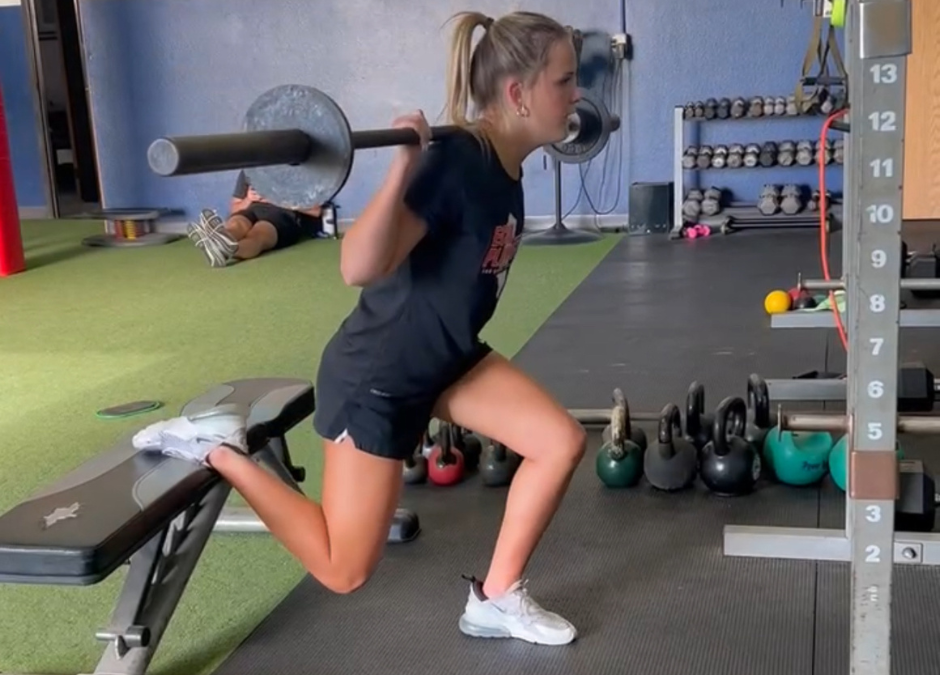
Should athletes still lift weights during their competitive season?
Absolutely.
The better question is: How often should athletes lift, and how should strength training change once competition begins?
An athlete’s training needs during the season are different from their needs during the off-season. Practices, games, tournaments, travel, and school already place demands on the body, so strength training needs to be strategic.
The goal of in-season strength training is not to bury athletes with more work.
It is to maintain strength and power, address individual weaknesses, support injury resilience, and keep athletes prepared to compete.
How Often Should Athletes Lift During the Season?
For many athletes, two strength-training sessions per week is an effective starting point during the competitive season.
Some athletes may benefit from three sessions, while athletes with extremely demanding competition schedules may need fewer.
The correct frequency depends on the athlete’s total workload.
Consider:
- How many games are scheduled each week?
- How many practices?
- How physically demanding are those practices?
- Is the athlete traveling?
- Are they playing tournaments?
- How well are they recovering?
- Are they dealing with any injuries or persistent soreness?
An athlete playing one game per week may have significantly more training capacity than an athlete competing multiple times throughout the week.
That’s why in-season lifting should be individualized rather than based on a one-size-fits-all schedule.
In-Season Lifting Is Not Off-Season Lifting
One of the biggest mistakes athletes make is carrying their off-season program directly into the competitive season.
Off-season training may prioritize:
- Building maximum strength
- Increasing muscle mass
- Developing power
- Improving conditioning
- Addressing major physical limitations
During the season, the priorities shift.
The athlete is already accumulating workload through sport participation.
The weight room should reinforce performance rather than interfere with it.
That generally means managing volume, choosing exercises carefully, and avoiding unnecessary fatigue.
How Much Weight Should Athletes Lift In-Season?
There is no single percentage or load that is appropriate for every athlete.
In-season strength training should be challenging enough to provide a meaningful stimulus without creating excessive fatigue.
Athletes should generally avoid turning every session into a max-effort workout.
Instead, focus on:
- Strong technique
- Controlled repetitions
- Quality movement
- Appropriate loading
- Efficient sessions
- Adequate recovery
The goal is to leave the gym feeling like training supported your sport—not like you need two days to recover from the workout.
Focus on the Major Movement Patterns
In-season workouts don’t need dozens of exercises.
A strong program can be built around the major movement patterns.
Squat
Squatting and other knee-dominant movements help maintain lower-body strength.
Examples may include:
- Squats
- Split squats
- Step-ups
- Lunges
Hinge
Hip-dominant movements train the posterior chain and help athletes maintain strength through the hips and hamstrings.
Examples include:
- Deadlift variations
- Romanian deadlifts
- Hip thrusts
- Other hinge variations
Push
Upper-body pressing helps athletes maintain strength and stability.
Examples include:
- Bench press
- Dumbbell press
- Landmine press
- Push-ups
Pull
Pulling movements are important for upper-back strength and shoulder function.
Examples include:
- Rows
- Pull-ups
- Lat pulldowns
- Other pulling variations
Single-Leg Training
Athletes rarely compete with both feet planted symmetrically.
Single-leg exercises can help develop strength, stability, and control.
Core and Trunk Training
The trunk plays a role in force production and transferring force between the lower and upper body.
Core training should be selected based on the demands of the athlete’s sport rather than simply adding endless abdominal exercises.
Don’t Forget Sport-Specific Accessory Work
The major lifts are only part of the equation.
Athletes may also benefit from targeted work based on their sport and position.
For example:
Baseball players may need shoulder stability, rotational strength, and arm-care work.
Soccer players may benefit from additional ankle, hamstring, hip, and groin work.
Basketball players may need continued attention to landing mechanics, single-leg strength, and lower-leg capacity.
Hockey players may benefit from hip, groin, and rotational training.
The best program considers what the athlete is already doing, and what is missing.
When Should Athletes Lift Around Games?
Timing matters.
A strength workout should not unnecessarily compromise an athlete’s ability to compete.
For athletes with one competition per week, strength sessions may be distributed more easily throughout the week.
For athletes with multiple competitions, the schedule may need to become much more conservative.
The closer an athlete gets to competition, the more important it becomes to manage fatigue.
This is why a training calendar should be built around the athlete’s actual competition schedule rather than using the same weekly template every week.
What About the Day Before a Game?
There is no universal rule that athletes should never lift the day before competition.
The answer depends on:
- Sport
- Position
- Competition schedule
- Training age
- Exercise selection
- Training volume
- Individual response
A well-designed session can look very different from a demanding strength workout.
The mistake is assuming that “lifting” automatically means creating significant fatigue.
Good in-season programming controls the training dose.
How Long Should an In-Season Workout Be?
In-season workouts can often be shorter than off-season sessions.
A focused 30–60 minute workout may be enough for many athletes.
The goal isn’t to fill an hour with exercises.
It is to accomplish the most important work efficiently.
An effective session might include:
- Dynamic warm-up
- Primary strength movement
- Secondary strength movement
- Upper-body push/pull
- Single-leg or accessory work
- Core or mobility work
The exact structure should be individualized.
What About Mobility?
Mobility work can be incorporated into warm-ups, cooldowns, recovery sessions, or lighter training days.
Common areas that may need attention include:
- Hips
- Ankles
- Hamstrings
- Shoulders
- Thoracic spine
But mobility should be based on the athlete’s actual movement needs, not simply because a particular stretch is popular.
The Goal Is Performance, Not Exhaustion
A successful in-season strength program should leave an athlete better prepared for their sport.
If an athlete is constantly sore, fatigued, or struggling to recover, more training isn’t necessarily the answer.
The program may need less volume, different exercise selection, better scheduling, or additional recovery.
In-season strength training works when the weight room complements competition rather than competes with it.
If you aren’t sure how often you should lift during your season, work with a qualified performance coach who can account for your sport, schedule, training history, and individual needs.
Compete Sports Performance works with athletes to develop training programs designed around the demands of competition, not against them.